
By Boago Benedict Samakabadi
The eatery was erected towards the North, out of Letlhakane towards Orapa, which was actually more west than north. There, beside the A14 highway, a few hundred paces from the junction to the Karowe mine. Almost isolated among the mopane, it radiated its own unique brilliance in the auspicious Boteti kimberlite force field, according to some people.
“It is like a sequin, or strass, set on an infinite backdrop of black velvet.”
“Not unlike everything else in Boteti, then.”
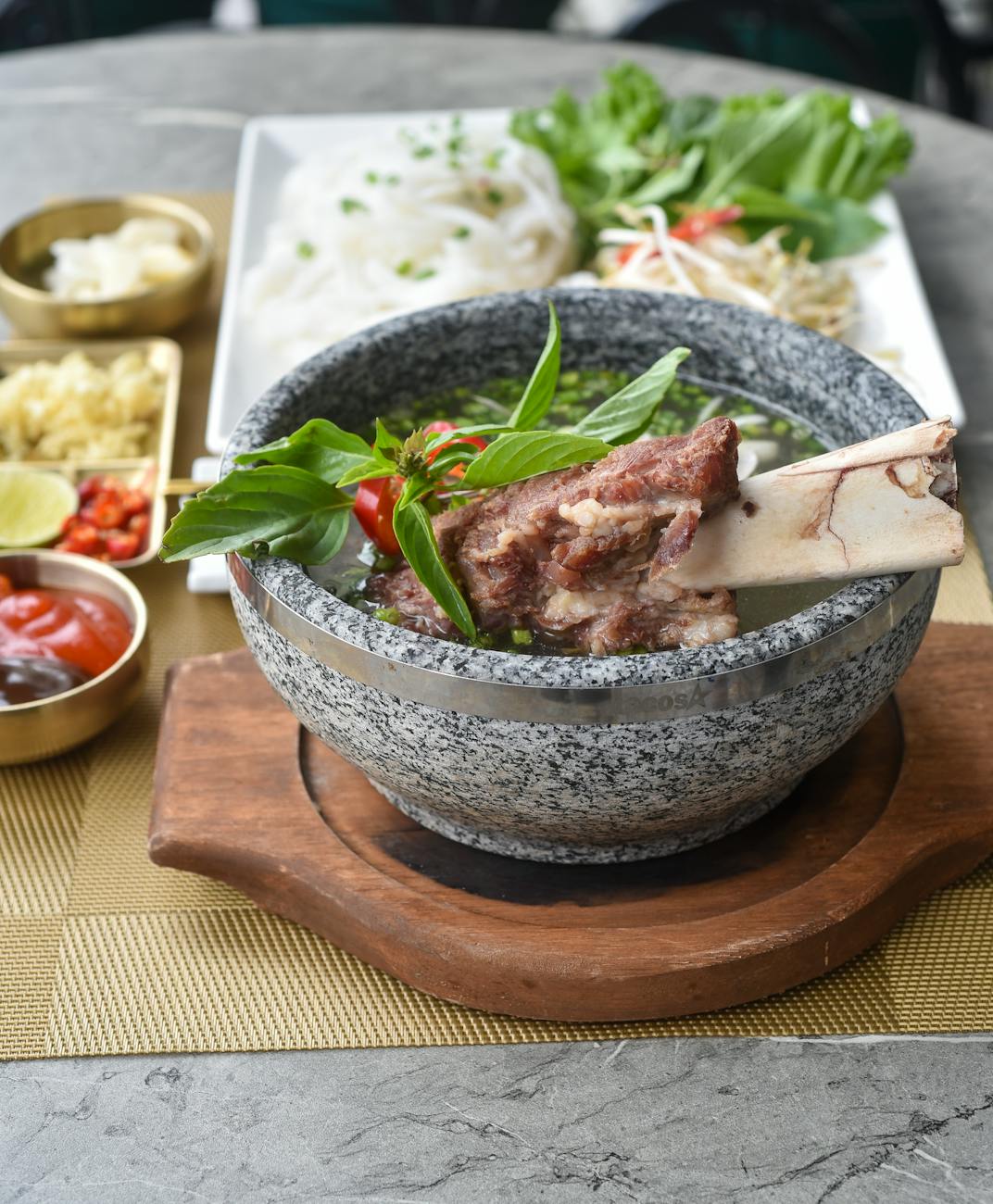
Those coming into the village from the general North called it “e e Mashetla”; and to those coming from elsewhere going out of the village to the North, it was “e e Marapo”. In either case, the epithets were apt qualifiers for the eatery’s actual name: Tshwapa. Appetite, gusto, relish. The former qualifier alluded to spongy bone, while the latter spoke of bone in general. Both were euonyms, speaking of a ravaging appetite and also an appetite for bones. The eatery sold bones—prepared au naturel, or seasoned with spices, or with condiments. Bones, tendons, ligaments, and cartilage.
Those unfamiliar with Setswana knew it as Bones-R-Us, Boners for short. And even those names spoke of a variety and plenitude of bones to pick from to satisfy any hunger and itch.
It was a delicatessen in a way, for the niche cuisine of osteophagy; bone-eating. Bones from all edible meats — beef, mutton, chevon, pork, lamb, chicken — were on the menu, as long as they were cookable and eatable. Even exotic (and hardly legal) bones of antelope, meerkat, hare, monitor and crocodile sometimes found themselves on the roster .
Tshwapa was a solid-looking makeshift structure of pallets, planks, cardboard, mopane poles, old tyres, and corrugated iron sheets. There were four bench-tables that could seat six people each, but the main sitting area was the ground, where animal skin mats were placed strategically under the shade of the mopane trees. This assemblage added to its overall allure. It was as if it was announcing itself as a phenomenon, a passing wonder among many other dazzling wonders, and only here to fix a super-specific hankering. Once sated, this hankering would probably relocate to another space-time, and, people speculated, there also would Tshwapa sprout. Much like it had sprouted in the collective consciousness of the A14 trekkers, seemingly overnight, a few months ago.
It was newer still in some people’s eyes; only a few weeks — or even a few days — old. It was new to somebody almost every day. Though stationed so prominently, it was hidden altogether, seemingly discoverable only in the fortuitous instant when one craved boiled bone. Therefore, only those with a taste and fetish for bones knew Tshwapa e e Mashetla and Tshwapa e e Marapo.
The deli had only two habitues, the true aficionados, who only came at a particular time, usually to order a particular dish. However, most of the custom came from passers-by, those suddenly possessed and in need of a satisfying exorcism right there and then. Most of them were in transit to the wider North, and when they arrived at their destinations, they rarely talked about Tshwapa e e Marapo; they would generally speak of an unnameable satisfaction in Boteti, the land of the diamond. Though unnameable, they knew it was grounding, emptying, freeing. It was also rejuvenating and… spiritual.
From the greater North into the village, or passing to the greater South or East, the customers could also not describe Tshwapa e e Mashetla, except for a resounding synchronicity, a renascent singularity they had experienced somewhere in the region.
It was most peculiar, although it really did not have to be. What was bone, after all, if not the factory of the lifeblood itself? What was bone if not the pillar of structure, of form, of grounding and rooting on ancestors; of towering and nearness to God? Bones brought all creatures closest to their ancestors below and closest to God above. In them, they hid records of time, of knowledge, of experiences. So, when the customers devoured the bones, they also devoured all that time, all that life, knowledge and all those experiences cocooned in the bones. They devoured the essence of spirit and the core of the soul when they devoured the bone itself.
Crushing the spongy bone between their teeth, the savoury fatty ichor contained in the lattice cascaded onto their tastebuds, delivering the minerals from the pastures and saline Boteti waters that had sustained the animal in life. The satisfaction from this catabolism on the palate was enhanced by the pleasurable pressure on the anchors of the molars deep in the gums as the teeth crunched, crushed, gnawed, ground and milled the bones.
Overall, the sensation was arresting; and then freeing again. The bone-eaters spoke about this arrest-release phenomenon, only they spoke of it in a general way.
“You cannot understand it until you feel it yourself,” one said.
“It is a looping wave of suspense and satisfaction, and you control the magnitude, length and the rapidity,” said another.
Yes, it was strange. But even stranger was the proprietor, Tatso. He was at once someone completely familiar and alien. No one knew him from the village, not that they were actively searching for him. Whom would they say they were searching for? Who was he? What did he do? They did not know because there was nothing to know. Tshwapa was an instantaneous affair, a fleeting wonder to attend a discrete urge in a discrete time and space. It was a specific jigsaw piece bound for its specific place in the puzzle. It was not transferable; at least not to the out-of-body world, a world apart from that of bone-eating fetish and relish.
It did not help that the project also demanded total immersion, a streamlining of all the bone-eater’s faculties into its singular execution, so that nothing else on the periphery mattered to them. Even matters that should have raised alarms, like where Tatso procured his bones from; or why they were so deliciously addicting; or why he was always so obliging. He once said that his customers’ satisfaction was the primary priority of his — the primary and terminal priority. But, so entranced and listless, nobody ever sought elucidation.
Tatso had two cooking assistants, Kgorô and Tsemêla, who attended to the many different pots. They also tended the fire while Tatso did everything else in the service of Tshwapa and its customers. People knew Kgorô and Tsemêla, but even when they met them in the village or elsewhere, they could not recall where they had seen them before. They were just familiar; intimately familiar.
***
The two aficionados, Tswapola and Ntšwapê, were just ordinary members of society. Their appetite for bones was heightened to near pathological degrees, and they seemed to have an alien tolerance for the all-out exertion employed in resolving that appetency. Theirs went beyond just osteophagy; it bordered on philia and mania.
If they had the scope of description, the bone-eaters would say that the resolution felt absolute and final. It felt like it was a schism between body and soul, or flesh and mind, where one went into space and another into the abyss, so that the separation was apparent. They would describe it as death, or at least, deathlike. Going there only once and never again was the norm with everyone because, after all, one ought to die only once.
But not Tswapola and especially not Ntšwapê. Tatso was bemused, wary, and maybe a little worried. Most patrons came just for the bones; they might be particular about the kind of bones they wanted, or if they wanted more cartilage, or tendons, or broth, or extra salt, or chilli flakes. But usually, the particularness ended there. It was doable and reasonable. However, with these two, it seemed like they were in competition to see who was the more taxing and vexing. Nonetheless, Tatso had matched their every whim and fancy, every quirk and kink. They were never satisfied. In fact, every session seemed to deepen their respective appetites, but methodically. By now, Tatso was attuned to their discriminating antics.
Tswapola, the gentlewoman, came by every Friday evening, bound for a weekend in Orapa. Her Corolla made a whirr that Tatso could tell apart from many other whirrs many kilometres away. That way, he tuned his body and soul for her before she ever got there. Her usual order was vertebrae, either mutton or chevon, with a bit of spinal cord inside. She would have her bones cross-legged on a black goatskin mat under the solitary acacia within the compound. After she was done, the bones were not recognisable as most of them would have been gnawed and milled to bonemeal, neatly heaped to the side in the yellow enamelled Kango basin. Her drink of choice was chilled rainwater in a yellow enamelled Kango cup.
Sometimes Tswapola came on Monday evening when she would be coming back to the village. She would ask for two beef femur “ball ends” containing bone marrow “to go”, and Tatso would remind her that the establishment did not serve food “to go”. After dickering for about a minute or so, she would relent and ask that they be served in a prison-style stainless steel plate, with a Kango cup of motsiara tea, and the thinnest or tiniest teaspoon for the marrow. She would then carry her food on a wooden tray and eat it on a bench-table, her back towards Orapa and the setting sun. Tatso had searched the entirety of the village for a supplier of motsiara tea (an infusion of the pods of the purple-pod terminalia tree) and the first time Tswapola tasted the tea, she had splattered it to the ground in disgust.
“Source your motsiara pods from Mopipi!” She was swabbing her tongue with a serviette, a frown etched between her eyebrows. “Specifically, at Ghubaga, beyond the salt pan. And use mineral water from a traditional well, preferably from the same area as the motsiara.”
The complaisant owner had seen to it that he procured the correct products in dedication to the woman.
Perhaps more difficult was Ntšwapê, the gentleman. He came on Tuesdays and Thursdays, without fail, and each time with a request or question more outrageous than the last. The first time he was there, he curiously asked why he did not know Tatso, insisting that he knew everyone in the Boteti territory.
“I come from the Kalahari,” Tatso had answered vaguely.
“How much can I order, in quantity?” Ntšwapê had ventured almost immediately.
“You eat what your body can carry—”
“—Can I order different species?”
“Yes. Also—”
“—Do you have donkey head?” He was drumming his fingers on the makeshift counter. It was really the door of the rectangular opening in the front used to issue wares and change. It opened downward and now stood propped on planks on either of the unhinged sides. “I want a donkey that has ploughed the fields of Boteti River.”
Tatso was astounded, but not by the specificity. Honestly, Ntšwapê looked like the type to be punctilious to that degree. The owner was bemused because the use of donkeys as draught power for ploughs in this region had been obsolete for at least two decades. There simply was no such donkey, in Boteti or on the menu.
“I’m afraid I don’t have donkey bones today. I might have them starting next week, though. You are the tenth person this week who asked for donkey.” There seemed to be especial gusto for donkey bones, and until it was duly indulged, the cravers would just keep on multiplying together with that gusto.
That day, Ntšwapê had gone home without satisfying his appetite. The next day, he had asked for catfish head accompanied by an assortment of bones from other fish species, adding, “I know the river has not yet come, but you are the bone man, aren’t you?”
Needless to say, the first meal he would actually have would be two weeks later, on a Thursday, when he asked for goat head and a Sprite. Over the weeks, Tatso realised that the man did not have a particular route or any identifiers that would announce his approach so that they could prepare themselves for him. He just materialised arbitrarily from anywhere, but always on those two days and around midday.
***
After some time, with everybody else, it became simple. The fetish seized them, they were called to Tshwapa in just that serendipitous instant, they came, ordered and ate what they could, and then they left. Beyond the normal pleasantries, they mostly kept to themselves, only conversing with their companions, if they had come with any. After all, the main conversation was between the person’s capacity for bone and their capability to fill that capacity. Their brain sicced the stomach, and the teeth and tongue went hunting.
It was primal, an instinctive matter of course that followed the usual sequence in a call-and-response. To try to explain it in any language at all would be to cheapen it, to adulterate it, maybe dehumanise it when the urge was clearly just human. Or perhaps, could it have been that it was not human at all, and to put a label on it was to humanise it, therefore limiting and minimising it? No one really understood this phenomenon, definitely not enough to describe it adequately or justify it. Why did they eat bone? Why so much effort for so little substantial gain? Was it to compensate for a physical deficiency, or maybe a metaphysical one? Was it a compulsion, or a symptom of a physiological handicap?
When the topic was broached one day, Tswapola had tried to explain why a person — any other except herself — would forego the beef for the bone. In her unique stilted, stencilled way, she had talked to everyone within earshot, saying it was the final display of human supremacy: “We have ridden the beast, drunk its milk, cut its tail for wizardry, cut its horns for flutes, used it to draw our carts, to plough our food, settled debts with it, married a bride with it, killed it, eaten its meat and worn its skin. Crushing its bones and devouring all their prized secret elements is the final defeat. It says, ‘Even the life fossilised within the bone, the spirit, the soul, belongs to us and not you beast and your bestial ancestors’.”
Yes, there was the idea that the only animal with a soul was human, but if animals were of God, then the argument could be made that they contained a bit of God in them, and that could constitute soul. Tshwapa operated within that consciousness, as well as the consciousness of a reconciliation between the souls of all blooded creatures. It seemed like Tswapola also believed in this idea. However, her justification was a little overkill: The message did not register because the beast it was directed to was long dead and devoured.
No, the explanation was probably much simpler than that, but that simplicity was not to be expected in the woman who occasionally enquired about the type of firewood they used and what flavour profile it imparted to the bones and their viscous broth. Tswapola required symmetry in her mutton or chevon vertebrae; it had to have been isolated whole from the rest of the carcass, with the ribs cleanly and equally sliced on both sides, and with the spinal cord still inside. Individual bones had to have been cleanly sliced on their joints. Yes, expecting a simple justification for her bone-eating fetish was impossible.
Curious, Tatso had asked Ntšwapê one day. Everybody else came only once, and after their singular fill and fulfillment, never again. If they came back, it was much later in the future, and randomly. Why did he come back, religiously and routinely?
“I love eating bones,” he had said, smacking his lips after grinding an entire chicken skeleton to a few balls of bonemeal. “I love the taste, the metallic taste… the mineral taste. It is also good exercise for the teeth and the gums, you know?”
Still, someone might have thought it a bit less pedestrian. Like Kgorô, who said: “It’s good exercise for the vessels in the temples. Once they get to pumping, the brain gets to thumping. You exhaust your jaw just to open your mind.”
And maybe all of them were right. It was all those things and more. They felt powerful grinding those bones with their teeth and sucking the savoury sap cocooned in their matrices. They just enjoyed the mineral flavour. It was good exercise for the gums and blood vessels in the head.
Or perhaps this was a method of food frugality, because the attendant consequence of the osteophagic ritual was the nearly cramped jaws which were so exhausted that eating anything for some time was out of the question. The almost climactic fatigue gave the illusion of fullness, but since the tongue, teeth, gums and jaws were so battered, it would be a while until the stomach was comforted with something heartier, something that would stick to the ribs. Alternatively, when they felt peckish, they could always come by Tshwapa for a plate of cheap brothy bones, because it was always open…
Boago Benedict Samakabadi wrote his first story in 2006, a Barbie/Harry Potter/Final Fantasy hybrid fanfiction, a dystopian world of magic and beauty. He mostly writes speculative fiction. His interest in storytelling comes from trying to find deeper meaning in nature, the universe, and the lesser explored depths of human psychology. If no such meaning exists, he tends to create it through his stories.

 Petlwana Journal of Creative Literature and the Arts
Hello! Anybody here?
LikeLike