
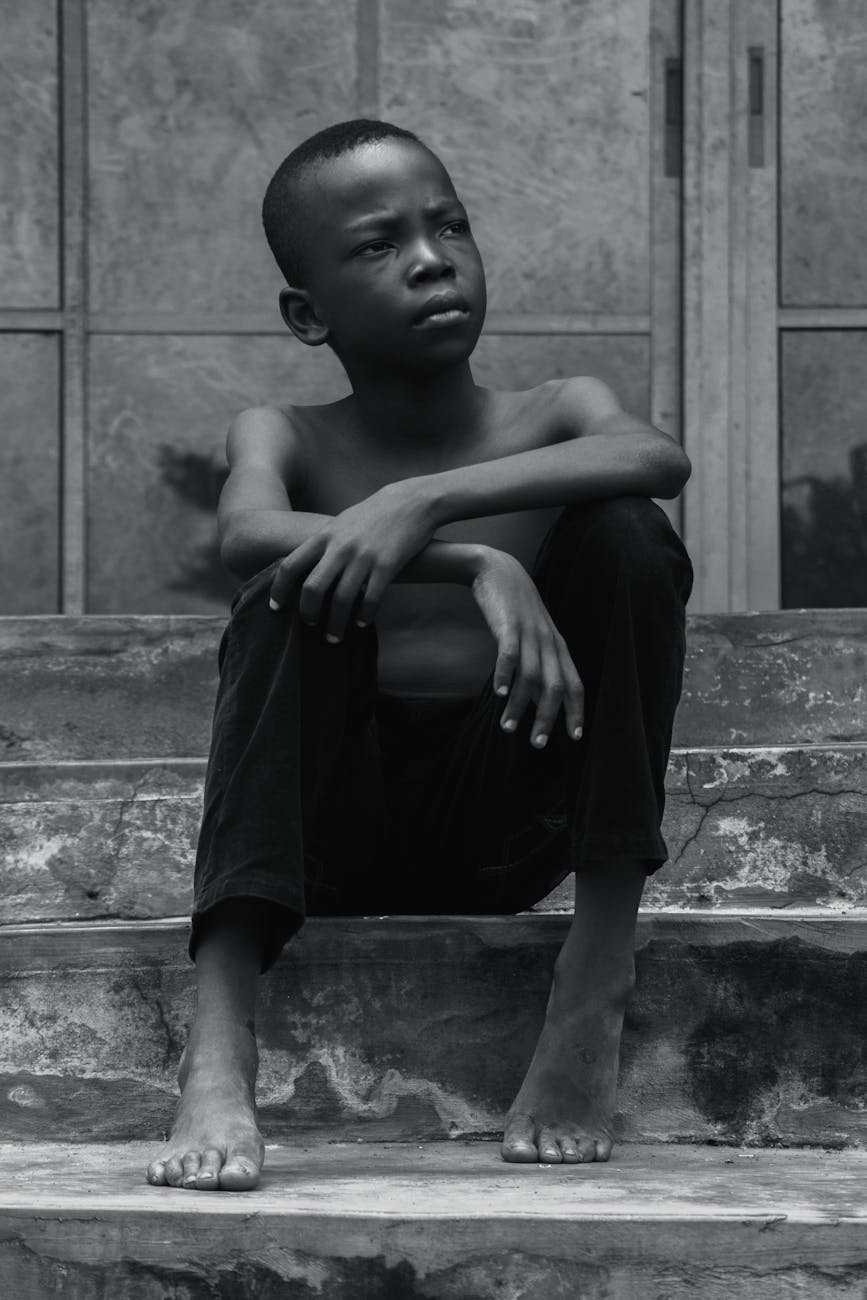
By Neelo Lentebanye
A letter to my younger self-and to every boy child still running. Inspired by the story of a friend.
Dear Lebang,
You were five.
Just a little boy with dust-coated heels and a wild imagination, growing up in Mosetse village, where the air always smelled of wood-smoke and cow dung. You often chased butterflies through the maize fields ko masimong, thinking they were messengers from your ancestors. The mornings always began with mabele porridge and sometimes in the right season you would eat it with madila.
You believed those fields could hide you. That if you ran far enough, the pain wouldn’t follow you.
I don’t remember the exact day it started. Trauma rarely sends a calendar invite. It slips through cracks in the walls, hides behind everyday moments, and speaks in voices no one else can hear.
I’m 45 now. And still, some nights I dream of you, your small frame darting barefoot between stalks of lebelebele in the Mosetse sun. I watch from afar as you run, the dust curling behind your heels. You’re not laughing. You’re gasping. You’re not playing. You’re fleeing.
And I know where you’re trying to go.
To masimo, where Rre and Mma spent most of their days. Where they planted and watered and harvested. They were farmers, and those farmers trusted their family, so they left you with her. You stayed with Mmamogolo – our aunt – and her son, Boreng.
You never knew how to explain it. At first, it was small things. Her hand lingering too long. Her voice softening when she called you monna wa ka, like a joke only she understood. You didn’t have the words for it then, but your stomach knew. Something twisted every time she touched your shoulder and called you to the mud hut. By nine, three years in, you started to understand. She wasn’t just being affectionate. She was taking things from you. Small pieces of your innocence. Your peace.
But you kept quiet.
Because in Mosetse, ngwana does not accuse Mmamogolo. In our world, go bua nnete –speaking the truth – can get you in more trouble than the truth itself. Rre would have said, “Don’t speak carelessly. That’s your elder.”
Mma would have asked, “Batho ba ta reng, Lebang?”
So you folded into yourself. Hid in plain sight. Silence became your survival.
Then, suddenly, she died. You were around 10. They said it was her heart. One day she was shouting at Boreng about firewood, the next, her body lay still and breathless on the mud floor. The village gathered. The women wailed in shawls and headscarves. The men sat in the shade, speaking in lowered voices. I was there, amongst strangers and familiar faces, doing this and that, but mostly listening to the cries. But inside me? Silence. And something else.
Relief.
Not joy. Not cruelty. Just a hollow, quiet breath that filled a place where shame had lived.
Tjo! It was over.
But here’s the truth no one tells boys like you and me: Trauma does not die with the abuser. It grows. Changes form. Moves in with you. I carried it with me into adolescence, into manhood. I carried it into my marriage.
I met Setho when I was 29. I married her at 31. By 32, she was gone. Twelve months. One full year of trying. She used to say, “Lebang, I don’t know how to love someone who’s always halfway gone. Your body is here, but your soul – ke gore, I don’t know where you are.”
And she was right.
I didn’t know how to be touched with tenderness. I didn’t know how to be vulnerable without fear. I didn’t know how to let love stay. Trauma had taught me to shut down before the fire ever started. To close doors that weren’t even open yet. After that? Relationships? I failed again. And again. And again. Everyone around me – cousins, siblings, old schoolmates – they built families. Paid magadi. Had babies who called them “Papa.”
And I became the polite uncle at weddings. The one people pity quietly.
“O tsile go aga lapa leng, monna?”
“You’re not getting any younger.”
“You’re a man. How can you not have a household?”
Little do they know.
I am in my third month of therapy now. I go to a quiet office in Gaborone, where a woman named Naledi listens like no one ever has. She doesn’t blink when I tell her about you. She doesn’t judge. She offers space. Safety. And the strange part? She doesn’t remind me of Mmamogolo. That matters more than you’d think.
She told me, “You’re still him – the little boy in Mosetse. But you don’t have to be only him.”
That’s why I’m writing you this letter.
To say what we never got to say. To take back what was taken.
Because ga o a senyega.
You are not broken.
You are not dirty.
You are not weak.
You didn’t ask for it.
You didn’t deserve it.
You were just a boy.
And you are still worthy of love. Of healing. Of a family – even if it doesn’t look like everyone else’s.
I know you’re tired. I know you still run in that field, in your dreams. I see it. You – barefoot – chasing something. Crying. Calling out. Running toward the edge of the maize field, hoping to find Rre and Mma. But they never turn. You never arrive. I used to think that dream was just a memory.
But now I know – it’s time to stop running. Or at least to arrive.
Let the wind blow. Let the maize bend and sway. Turn around. Walk back. Come home. You have nothing left to prove to anyone. Let them talk. Let them misunderstand. Monna ke nku – o a bogelwa. Yes, a man is watched silently. But I am done suffering quietly. I am learning to breathe. To forgive myself. To live.
So to you, little Lebang – and to every boy sitting in a silent room, afraid to speak:
You are seen.
You are enough.
And you are no longer alone.
One day, you’ll stop dreaming of that field. Because one day, you’ll realize –
You already reached the other side.
With all my heart,
Lebang (45 and finally breathing)
Neelo Lentebanye is a multidisciplinary creative professional working at the intersection of theatre, cultural development, and visual arts. With a Bachelor’s degree in Fine Arts -Theatre, and further training in film and television, she has written, directed, and produced socially engaged plays and films that address themes such as gender-based violence, human trafficking, identity, and cultural preservation. In 2018, she founded Neelo Management & Consultancy, a creative firm offering arts consultancy and cultural project management services. Through this NMC, she has worked with key organisations including UNICEF Botswana, BITC, FNB Botswana, Native Impressions, and the Ministry of Sports and Arts (then MYSC).
Neelo has curated and managed several high-impact programmes and campaigns such as the Eseng Mo Ngwaneng national awareness campaign, the Global Expo Botswana 2018 Guerrilla Marketing Campaign, The Bots50: A Road to Self Rule theatre production (Co-Writer), and served as the Lead Coordinator for the Botswana Youth Awards from 2018 to 2020 under Remmogo Foundation. She previously worked at the University of Botswana under the Arts & Culture unit, where she led the development of vibrant arts initiatives for the student creative community.
Neelo is passionate about storytelling, and in every project – whether writing, directing, or curating events – she draws inspiration from lived experiences. Her goal is always to craft immersive narratives that invite audiences to fully lose themselves in the story.

 Petlwana Journal of Creative Literature and the Arts
The published words are relatable in every sense, I hope the young man in me heals. Thanks for this. 🙏🏾👏🏾
LikeLike